Saber vs Conocer: Examples and Practice
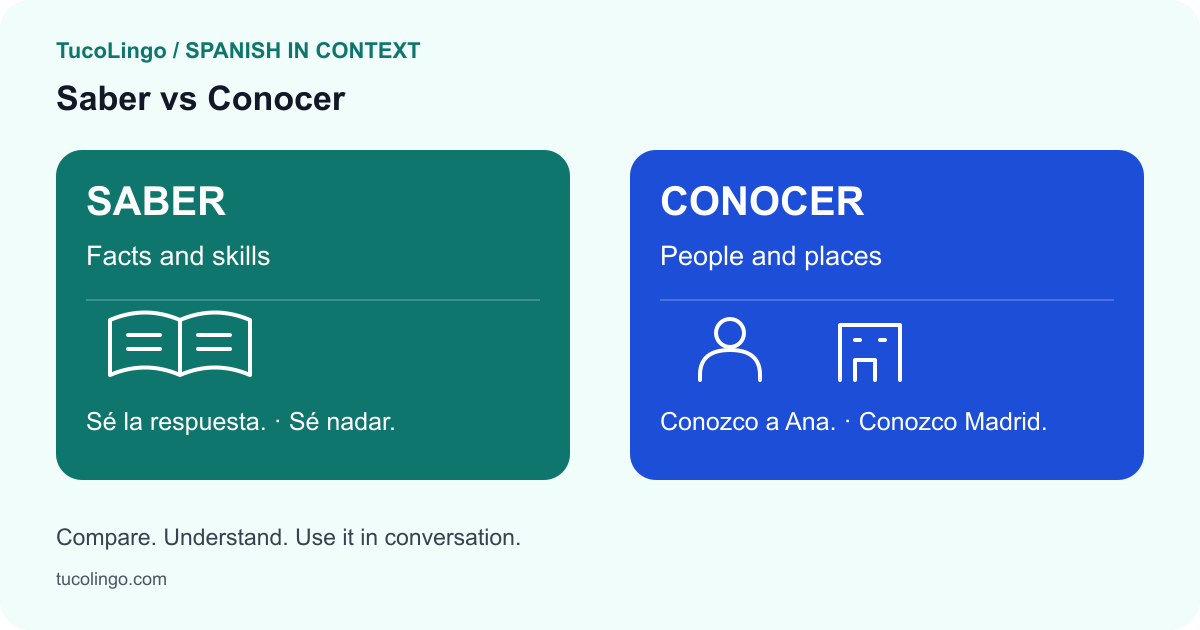
Use saber for facts, information and knowing how to do something. Use conocer for familiarity with a person, place or thing. “Sé dónde está Madrid” means I know where Madrid is; “conozco Madrid” means I am familiar with Madrid.
By the TucoLingo team · Updated
Free plan included · No credit card required
The difference at a glance
| Meaning | Choose | Example |
|---|---|---|
| A fact or answer | saber | Sé la respuesta. — I know the answer. |
| How to do something | saber + infinitive | Sé nadar. — I know how to swim. |
| Familiarity with a person | conocer + personal a | Conozco a Ana. — I know Ana. |
| Familiarity with a place | conocer | Conozco Madrid. — I know Madrid. |
The distinction is about the kind of knowledge, not how well you know something. “Sé mucho sobre Madrid” means you know a lot about Madrid; it does not necessarily mean you have been there. “Conozco bien Madrid” presents the city as somewhere familiar to you.
Saber: information and skills
Use saber before a fact, a question word introducing information, or an infinitive describing a skill. “Sé que llega mañana” means I know that she arrives tomorrow. “¿Sabes dónde vive?” asks whether you know where she lives.
For skills, Spanish normally uses saber directly before the infinitive: “Sé cocinar” (I know how to cook). Avoid translating every English word and saying “sé cómo cocinar” when you simply mean you have the skill. Cómo can be appropriate when the method itself matters.
| Person | Saber | Conocer |
|---|---|---|
| yo | sé | conozco |
| tú | sabes | conoces |
| él / ella / usted | sabe | conoce |
| nosotros / nosotras | sabemos | conocemos |
| vosotros / vosotras | sabéis | conocéis |
| ellos / ellas / ustedes | saben | conocen |
Conocer: familiarity, people and places
Use conocer when you are acquainted with someone or familiar with a place, book, restaurant or other thing. “¿Conoces este restaurante?” asks whether this restaurant is familiar to you. “¿Sabes dónde está este restaurante?” asks for information about its location.
An identified person normally takes the personal a: “Conozco a tu hermana” (I know your sister). A city does not: “Conozco Sevilla.” Conocer is also used when meeting someone: “Quiero conocer a tus amigos” means I want to meet your friends.
What changes in the past?
The preterite often presents a new piece of knowledge or a first encounter. “Supe la noticia ayer” means I found out the news yesterday. “Conocí a Ana ayer” means I met Ana yesterday. In contrast, “sabía la respuesta” describes already knowing the answer, and “conocía a Ana” describes an existing acquaintance.
Context matters: do not replace every past-tense “knew” with supe or conocí. Ask whether you are describing an existing state of knowledge or a discovery or encounter. This connects directly to the distinction between the preterite and imperfect.
A conversation about a new city
Ana: ¿Conoces Valencia?
Are you familiar with Valencia?
Sam: No, pero sé que está cerca del mar.
No, but I know it is near the sea.
Ana: ¿Sabes nadar?
Do you know how to swim?
Sam: Sí. ¿Conoces alguna playa tranquila?
Yes. Do you know any quiet beaches?
Practice: saber or conocer?
Choose the verb and form that fit the meaning. Open each answer when you are ready; there is no score.
Yo ___ la respuesta.
Show answer and explanation
Sé. An answer is information: “Sé la respuesta.”
¿Tú ___ a mi hermano?
Show answer and explanation
Conoces. You are asking about acquaintance with a person.
Nosotros ___ cocinar.
Show answer and explanation
Sabemos. Use saber + infinitive for a skill.
Ella ___ bien Barcelona; vivió allí diez años.
Show answer and explanation
Conoce. Living there gives context for familiarity with the city.
Ayer ___ a mi nueva vecina por primera vez. (yo)
Show answer and explanation
Conocí. This is a first meeting, presented as a completed event.
Ya ___ la respuesta antes de la clase. (yo)
Show answer and explanation
Sabía. The sentence describes knowledge that already existed, so the imperfect fits.
¿Ustedes ___ dónde está la estación?
Show answer and explanation
Saben. Dónde introduces a piece of information.
Translate: I know Ana, but I do not know her phone number.
Show answer and explanation
Conozco a Ana, pero no sé su número de teléfono. Familiarity and information require different verbs.
Take this into a conversation
Introduce an imaginary friend and describe a city you know. Then ask your tutor for information about a city you have never visited. Try “conozco”, “sé que” and “sé + infinitive”.
Use this task as a starting point when you talk with your AI tutor in TucoLingo. Take your time, then review the patterns you found difficult.
Sources and further reading
Keep learning
Preterite vs. Imperfect
Two Spanish past tenses, two different jobs — when to use each one.
Ser vs. Estar
The two Spanish verbs for "to be", finally explained so the difference makes sense.
Pedir vs Preguntar: Examples and Practice
Understand pedir vs preguntar in Spanish: requests, questions and restaurant examples. Try a short dialogue and eight practice questions with explained answers.
Now use it out loud.
Introduce an imaginary friend and describe a city you know. Then ask your tutor for information about a city you have never visited. Try “conozco”, “sé que” and “sé + infinitive”.
Free plan included · No credit card required