Preterite vs. imperfect: when to use each Spanish past tense.
Use the preterite to present a past event as a whole and the imperfect for background, ongoing situations and habits. Compare examples, follow a short story and practice choosing by context.
By the TucoLingo team · Updated
Free plan included · No credit card required
Why English speakers struggle with this
In English, "I went to the store" handles almost any past situation. In Spanish, you have to choose: "fui a la tienda" (preterite) or "iba a la tienda" (imperfect)? They mean different things, and getting it wrong changes the meaning of the sentence — sometimes subtly, sometimes completely.
The rule that actually works: preterite is for completed actions with a clear beginning and end. Imperfect is for ongoing actions, descriptions, or things that used to happen — without a defined endpoint.
Think of it like a movie. Preterite = the snapshots, the events that move the plot. Imperfect = the background, the scenery, the things that were always there.
See how a story combines both tenses
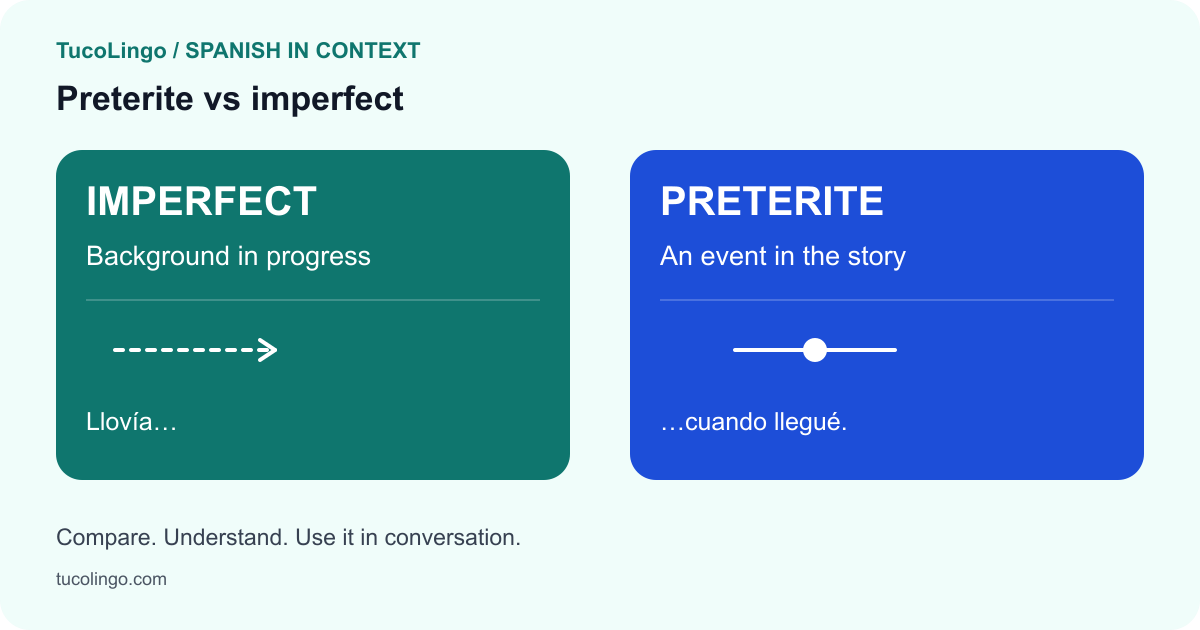
“Era viernes y llovía. Caminaba hacia casa cuando sonó mi teléfono. Contesté y hablé con Ana durante una hora.” It was Friday and it was raining. I was walking home when my phone rang. I answered and spoke with Ana for an hour.
| Phrase | Role in the story |
|---|---|
| Era viernes; llovía | Imperfect: setting and background. |
| Caminaba hacia casa | Imperfect: an activity viewed as ongoing. |
| Sonó mi teléfono; contesté | Preterite: events advancing the story. |
| Hablé durante una hora | Preterite: a bounded conversation, even though it lasted an hour. |
Duration alone does not choose the tense. A long event can use the preterite when presented as a bounded whole. An expression such as siempre or ayer gives context, but it is not an automatic tense switch. The speaker’s viewpoint matters.
When to use the preterite (pretérito)
Use the preterite for actions that started, ended, and are done. Single events, completed actions, things that happened a specific number of times.
Single completed events
"Ayer fui al cine." (Yesterday I went to the movies.) "Comió la pizza." (He ate the pizza — it's done.)
Actions with a clear endpoint
"Estudié por tres horas." (I studied for three hours — and then I stopped.) "Vivió en Roma cinco años." (She lived in Rome for five years — and then left.)
A specific number of times
"Lo llamé tres veces." (I called him three times.) "Visité México dos veces." (I visited Mexico twice.)
Sequences of events
"Llegué, abrí la puerta y entré." (I arrived, opened the door, and went in.) Each is a discrete action.
Expressions such as ayer, anoche, una vez and de repente often appear with completed events. They are clues, not automatic triggers: “Ayer llovía cuando salí” uses the imperfect for the rainy background.
When to use the imperfect (imperfecto)
Use the imperfect for ongoing or habitual past actions, descriptions, and background information. The action wasn't completed in a discrete moment — it was unfolding, repeating, or just ambient.
Habitual past actions ("used to / would")
"De niño jugaba al fútbol todos los días." (As a kid I used to play soccer every day.) "Iba al cine cada sábado." (I would go to the movies every Saturday.)
Descriptions and background
"Era un día soleado." (It was a sunny day.) "La casa era grande y tenía un jardín." (The house was big and had a garden.)
Ongoing actions interrupted by another
"Caminaba por la calle cuando vi el accidente." (I was walking down the street when I saw the accident.) The walking is ongoing (imperfect); the seeing is the interrupting event (preterite).
Age, time, and weather in the past
"Tenía 10 años cuando…" (I was 10 years old when…) "Eran las tres de la tarde." (It was three in the afternoon.) "Llovía mucho." (It was raining a lot.)
Mental and emotional states
"Estaba cansado." (I was tired.) "Pensaba en ti." (I was thinking about you.) "Sabía la respuesta." (I knew the answer.)
Expressions such as todos los días, normalmente, a menudo and cuando era niño often introduce habitual background. Context still matters: “Siempre supe la verdad” is a natural preterite sentence despite siempre.
Side-by-side examples that show the difference
Different verbs
"Cuando era pequeño, jugaba en el parque" (As a kid, I used to play in the park — habit) vs. "Ayer jugué en el parque" (Yesterday I played in the park — single event).
Same verb, different meaning
"Conocía a Juan" (I knew Juan — ongoing acquaintance) vs. "Conocí a Juan" (I met Juan — the moment of meeting). The verb conocer changes meaning between tenses!
Saber
"Sabía la verdad" (I knew the truth — already had this knowledge) vs. "Supe la verdad" (I found out the truth — moment of discovery).
Querer
"Quería ir" (I wanted to go — ongoing wish) vs. "Quise ir" (I tried to go) and "No quise ir" (I refused to go) — preterite often implies attempt or refusal.
Two tenses in one sentence
"Mientras leía, sonó el teléfono." (While I was reading, the phone rang.) Imperfect for the background, preterite for the interrupting event.
The "two tenses in one sentence" pattern is a goldmine for natural-sounding past Spanish. Master it and your storytelling jumps a level.
Quick decision tree
How to make it feel natural
Telling stories gives you a useful way to practice both tenses: set the scene with the imperfect, then describe events with the preterite. Repeated practice can help you connect the tense with the viewpoint you want to express.
In TucoLingo, ask the tutor to interview you about your childhood, your last vacation or a memorable day at work. Practice describing both the setting and the events, then review patterns you found difficult.
Practice with a short story
When I was a child, I played outside every day: “De niño, ___ fuera todos los días.” (jugar, yo)
Show answer and explanation
Jugaba. This describes a habitual childhood activity.
Yesterday I worked for eight hours: “Ayer ___ ocho horas.” (trabajar, yo)
Show answer and explanation
Trabajé. A long action can be presented as a completed whole.
It was raining when I arrived: “___ cuando llegué.” (llover)
Show answer and explanation
Llovía. The rain is the ongoing background to the arrival.
I found out the news yesterday: “Ayer ___ la noticia.” (saber, yo)
Show answer and explanation
Supe. The preterite presents finding out as an event; sabía would describe already knowing.
Build on this with another lesson
Keep practicing everyday choices with saber vs conocer for knowledge and familiarity, pedir vs preguntar for requests and questions, and llevar vs traer for movement and direction.
Keep learning
Saber vs Conocer: Examples and Practice
Learn when to use saber and conocer in Spanish with clear examples, common mistakes and practice questions. Then try both verbs in a real conversation.
Llevar vs Traer: Bring and Take in Spanish
Learn llevar vs traer with a direction diagram, translated examples and practice. See how the speaker’s location changes the choice between bring and take.
Pedir vs Preguntar: Examples and Practice
Understand pedir vs preguntar in Spanish: requests, questions and restaurant examples. Try a short dialogue and eight practice questions with explained answers.
Tell better stories in Spanish.
Once preterite and imperfect click, you stop sounding like a textbook and start sounding like someone who actually lives in the language. Practice both with TucoLingo.
Free plan included · No credit card required