Llevar vs Traer: Bring and Take in Spanish
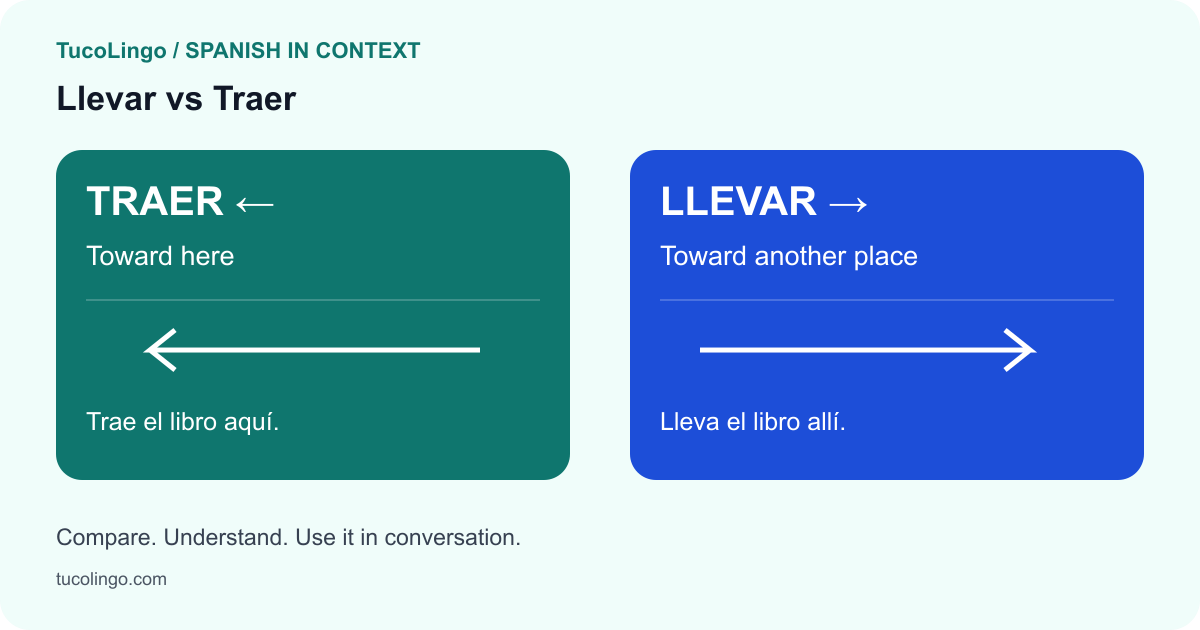
Use traer for movement toward the speaker’s location or the “here” established in the conversation. Use llevar for movement toward another place. First establish where the speaker is: “Trae el libro aquí” means bring the book here; “lleva el libro allí” means take the book there.
By the TucoLingo team · Updated
Free plan included · No credit card required
Start with the speaker’s location
| Situation | Verb | Example |
|---|---|---|
| I am at home; come here with bread | traer | Trae pan a mi casa. — Bring bread to my house. |
| I am at home; deliver bread elsewhere | llevar | Lleva pan a la oficina. — Take bread to the office. |
| I ask what you have with you here | traer | ¿Qué traes? — What have you brought? |
| I discuss what I will take elsewhere | llevar | Voy a llevar una chaqueta. — I will take a jacket. |
English often uses bring for movement toward the listener or a shared destination. Spanish does not always make the same choice. Rather than translating bring word for word, establish the reference point and the destination.
The same book, two different conversations
Imagine Ana is at home and Luis is at the library. Ana says, “¿Puedes traer mi libro a casa?” (Can you bring my book home?). The movement ends where Ana is, so traer fits.
Now Ana is at the library with Luis. She says, “¿Puedes llevar mi libro a casa?” (Can you take my book home?). Home is another destination, so llevar fits. The item and destination have not changed; the speaker’s position has.
In real conversations, people can establish a reference point beyond their immediate physical location, and usage can vary. Explicit aquí and allí make beginner practice clearer. Ask where “here” is before treating an isolated sentence as having only one possible answer.
Forms and other common meanings
| Person | Llevar: present | Traer: present |
|---|---|---|
| yo | llevo | traigo |
| tú | llevas | traes |
| él / ella / usted | lleva | trae |
| nosotros / nosotras | llevamos | traemos |
| vosotros / vosotras | lleváis | traéis |
| ellos / ellas / ustedes | llevan | traen |
The yo form traigo is irregular. In the preterite you will also hear traje (I brought) and llevó (he/she took). When practicing direction, using “voy a llevar” and “voy a traer” lets you keep the infinitive unchanged.
Llevar has other meanings: “Llevo una camisa azul” means I am wearing a blue shirt, and “llevo dos años aquí” means I have been here for two years. These are not movement choices. Learn them as separate patterns rather than forcing the direction rule onto every use.
Planning a visit
Ana, at home: ¿Vienes a mi casa? ¿Puedes traer pan?
Are you coming to my house? Can you bring bread?
Luis, outside: Sí. Voy a llevar pan y fruta a tu casa.
Yes. I am going to take bread and fruit to your house.
Ana: Gracias. Después tenemos que llevar estos libros a la biblioteca.
Thanks. Afterwards we need to take these books to the library.
Ana describes movement toward her home; Luis describes movement from where he is toward another place. This is why the speakers can use different verbs for the same delivery.
Practice with a clear reference point
You are at home: “___ el libro aquí, por favor.” (tú)
Show answer and explanation
Trae. Aquí is the speaker’s location.
You are at home: “___ este paquete a la oficina.” (tú)
Show answer and explanation
Lleva. The office is another destination.
I have just arrived here with coffee: “Te ___ café.” (present, yo)
Show answer and explanation
Traigo. The coffee has come to the current reference point.
We are leaving here for the beach: “Vamos a ___ agua a la playa.”
Show answer and explanation
Llevar. You will take the water to another place.
Complete the present form: yo ___, tú traes.
Show answer and explanation
Traigo. The first-person form of traer is irregular.
You are in your kitchen and ask someone outside to bring bread here. Which verb?
Show answer and explanation
Traer: “¿Puedes traer pan?” The destination is where you are.
Translate: I am wearing a blue shirt.
Show answer and explanation
Llevo una camisa azul. Llevar also expresses wearing clothing; this is a separate meaning.
Can you choose confidently from “¿Puedes ___ un libro?” without context?
Show answer and explanation
Not always. Establish who is speaking, where the book is going and what location counts as “here”.
Take this into a conversation
Tell your tutor where each person is. Arrange a visit, decide what to take, then switch roles so the host asks what the visitor can bring.
Use this task as a starting point when you talk with your AI tutor in TucoLingo. Take your time, then review the patterns you found difficult.
Sources and further reading
Keep learning
Pedir vs Preguntar: Examples and Practice
Understand pedir vs preguntar in Spanish: requests, questions and restaurant examples. Try a short dialogue and eight practice questions with explained answers.
Saber vs Conocer: Examples and Practice
Learn when to use saber and conocer in Spanish with clear examples, common mistakes and practice questions. Then try both verbs in a real conversation.
Ser vs. Estar
The two Spanish verbs for "to be", finally explained so the difference makes sense.
Now use it out loud.
Tell your tutor where each person is. Arrange a visit, decide what to take, then switch roles so the host asks what the visitor can bring.
Free plan included · No credit card required