Pedir vs Preguntar: Examples and Practice
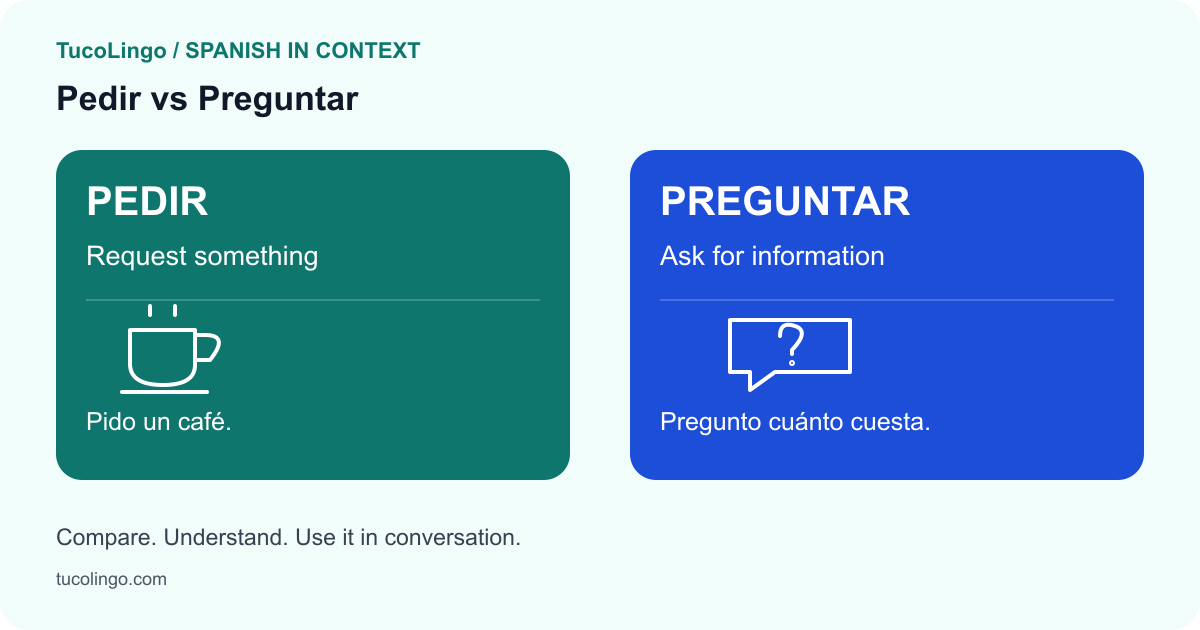
Use pedir to request something or ask someone to do something. Use preguntar to ask for information. “Pido un café” means I order a coffee; “pregunto cuánto cuesta” means I ask how much it costs.
By the TucoLingo team · Updated
Free plan included · No credit card required
Requests and questions are different jobs
| You want… | Use | Example |
|---|---|---|
| An item | pedir | Pido agua. — I ask for water. |
| A favor or action | pedir | Te pido ayuda. — I ask you for help. |
| An answer | preguntar | Pregunto la hora. — I ask the time. |
| Information about someone | preguntar por | Pregunto por Ana. — I ask about Ana. |
English “ask for” is a useful starting point, but not a perfect translation rule. “Ask for directions” often means request information, so “preguntar cómo llegar” is natural. Think about what you want the other person to provide or do.
How to build a sentence with pedir
For things, use pedir + noun: “Pedimos la cuenta” (We ask for the bill). You do not need por to translate the English “for”. “Pido ayuda” means I ask for help. In a restaurant, pedir also means to order.
To identify the recipient, use an indirect object: “Le pido un favor a Marta” (I ask Marta for a favor). For an action by someone else, pedir que commonly takes the subjunctive: “Le pido que hable más despacio” (I ask her to speak more slowly). You can begin with simpler requests before learning that construction.
| Person | Pedir: present | Preguntar: present |
|---|---|---|
| yo | pido | pregunto |
| tú | pides | preguntas |
| él / ella / usted | pide | pregunta |
| nosotros / nosotras | pedimos | preguntamos |
| vosotros / vosotras | pedís | preguntáis |
| ellos / ellas / ustedes | piden | preguntan |
How to ask for information
Preguntar can introduce the information you want: “Pregunta cuándo sale el tren” (Ask when the train leaves). It can also introduce a yes/no question with si: “Le pregunté si estaba abierto” (I asked whether it was open). Si here means whether or if; it is not sí meaning yes.
To say “ask a question”, use “hacer una pregunta”. “¿Puedo hacerte una pregunta?” means Can I ask you a question? To ask about someone, “preguntar por alguien” is a useful pattern. “Preguntó por tu madre” means she asked about your mother; it is not a request to receive your mother.
At a café: both verbs in context
Alex: Quiero pedir un café y una tostada.
I want to order a coffee and some toast.
Marta: Voy a preguntar si tienen leche de avena.
I am going to ask whether they have oat milk.
Alex: También podemos pedir un vaso de agua.
We can also ask for a glass of water.
Marta: Sí. Y después preguntamos a qué hora cierran.
Yes. And then we can ask what time they close.
Notice the difference between ordering an item and finding out a fact. Both happen in the same conversation; you do not need to memorize a separate verb for each setting.
Practice: requests or information?
Quiero ___ una pizza.
Show answer and explanation
Pedir. You want to order an item.
Voy a ___ cuánto cuesta la pizza.
Show answer and explanation
Preguntar. You want its price, a piece of information.
¿Puedo ___ una pregunta?
Show answer and explanation
Hacer. The natural expression is hacer una pregunta.
Nosotros ___ ayuda cuando la necesitamos. (present)
Show answer and explanation
Pedimos. Help is something you request; nosotros does not change e to i.
Ella ___ si hay una mesa libre. (present)
Show answer and explanation
Pregunta. Si introduces the information she wants to know.
Translate: I ask Ana for a favor.
Show answer and explanation
Le pido un favor a Ana. Pedir expresses the request, and le identifies the recipient.
Translate: Ask what time the train leaves. (tú)
Show answer and explanation
Pregunta a qué hora sale el tren. You want information about departure time.
What is the difference between “pidió agua” and “preguntó por el agua”?
Show answer and explanation
Pidió agua means he or she requested water. Preguntó por el agua means he or she asked about the water; the context supplies the particular question.
Take this into a conversation
Role-play a café visit. Order two things, ask about ingredients and opening hours, then request the bill. Try “quiero pedir” and “quiero preguntar”.
Use this task as a starting point when you talk with your AI tutor in TucoLingo. Take your time, then review the patterns you found difficult.
Sources and further reading
Keep learning
Por vs. Para
The Spanish prepositions that confuse everyone, with rules that actually work.
Llevar vs Traer: Bring and Take in Spanish
Learn llevar vs traer with a direction diagram, translated examples and practice. See how the speaker’s location changes the choice between bring and take.
Spanish Conversation: At the Restaurant
How to order, ask questions, handle the bill — real Spanish for restaurants.
Now use it out loud.
Role-play a café visit. Order two things, ask about ingredients and opening hours, then request the bill. Try “quiero pedir” and “quiero preguntar”.
Free plan included · No credit card required