Ser vs. estar in Spanish: the real difference, finally explained.
Two Spanish verbs that both mean "to be" — but they're not interchangeable. Here's the actual rule (it's not "permanent vs. temporary"), with examples and a trick that makes the choice automatic.
By the TucoLingo team · Updated
Free plan included · No credit card required
Forget "permanent vs. temporary" — that rule is wrong
You've probably heard the rule: "ser is for permanent things, estar is for temporary things." It's the most-taught explanation, and it falls apart on contact with reality. "I'm dead" is permanent — but in Spanish it's "estoy muerto", with estar. "I'm a teacher" can be a job you change next week — but it's "soy maestro", with ser.
The actual rule that works: ser tells you WHAT something is. Estar tells you HOW or WHERE something is. Ser is about identity and essence. Estar is about state, condition, and location.
Ask yourself: "what is this thing/person?" → ser. "How is it / where is it right now?" → estar. Use this as a starting point, then check the context and exceptions below.
Compare the same person in two ways
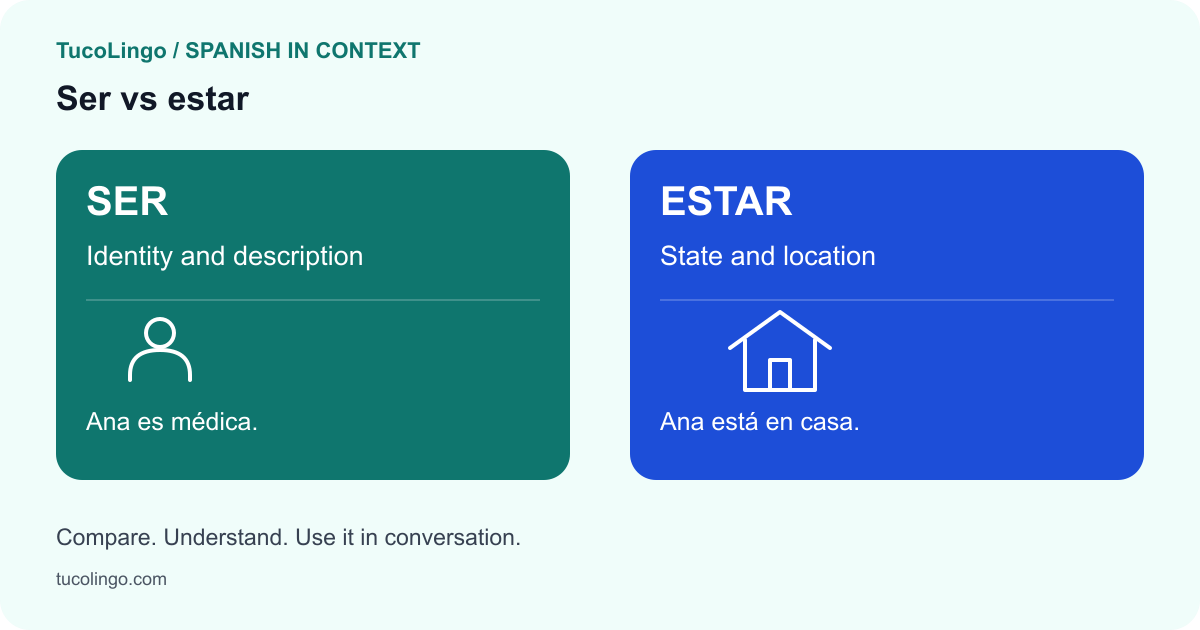
| Ser: identity or description | Estar: state or location |
|---|---|
| Ana es médica. — Ana is a doctor. | Ana está en casa. — Ana is at home. |
| Luis es aburrido. — Luis is boring. | Luis está aburrido. — Luis is bored. |
| El edificio es antiguo. — The building is old. | El edificio está vacío. — The building is empty. |
| La fiesta es en casa. — The party takes place at home. | Los invitados están en casa. — The guests are at home. |
Do not treat “what vs how/where” as a rule without exceptions. Use ser for when and where an event takes place: “El concierto es el viernes” and “El concierto es en el teatro”. An event’s location is different from the location of a person or object.
When to use ser
Use ser to talk about what something IS — the things that define identity, regardless of how they might change.
Identity and description
"Soy María." (I'm María — my name.) "Es alta." (She's tall — physical description.) "Soy paciente." (I'm patient — character trait.)
Origin and nationality
"Soy de México." (I'm from Mexico.) "Es japonés." (He's Japanese.)
Profession
"Es médico." (He's a doctor.) "Soy estudiante." (I'm a student.)
Time, dates, days
"Son las tres." (It's 3 o'clock.) "Hoy es lunes." (Today is Monday.) "Es el cinco de mayo." (It's May 5th.)
Relationships
"Es mi hermana." (She's my sister.) "Somos amigos." (We're friends.)
Possession and material
"Es mío." (It's mine.) "Es de oro." (It's gold / made of gold.)
Events and locations of events
"La fiesta es en mi casa." (The party is at my house — for events, ser is used.)
When to use estar
Use estar to talk about HOW or WHERE something is — states, conditions, emotions, locations, ongoing actions.
Location of objects/people
"Madrid está en España." (Madrid is in Spain.) "Estoy en casa." (I'm at home.) Note: location of EVENTS uses ser, but location of things/people uses estar.
Emotions and moods
"Estoy feliz." (I'm happy.) "Está triste." (She's sad.) "Estamos cansados." (We're tired.)
Physical conditions and health
"Está enfermo." (He's sick.) "Estoy bien." (I'm fine.) "Estamos vivos." (We're alive.)
Ongoing actions (with -ando/-iendo)
"Estoy comiendo." (I'm eating.) "Estás trabajando." (You're working.)
Results of actions
"La puerta está abierta." (The door is open — someone opened it.) "La sopa está fría." (The soup is cold.)
Marital status
"Está casado." (He's married.) Estar is common for marital status. Forms with ser, such as "es casado", also occur in some varieties and contexts.
Same word, different meaning
Some adjectives change meaning depending on whether you use ser or estar. This is where the "what vs. how" rule really pays off.
Aburrido
"Es aburrido" = he is boring (his nature). "Está aburrido" = he's bored (his current state).
Listo
"Es listo" = he's clever / smart. "Está listo" = he's ready.
Rico
"Es rico" = he's rich (wealthy). "Está rico" = it's tasty / he's attractive (informal).
Bueno
"Es bueno" = he's a good person. "Está bueno" = it tastes good / he looks good (casual).
Malo
"Es malo" = he's a bad person. "Está malo" = he's sick (or it's gone bad — like food).
Verde
"Es verde" = it's green (the color). "Está verde" = it's unripe.
Test yourself: how would you say "the soup is cold"? It's "la sopa está fría" — temporary state. How about "snow is cold"? "La nieve es fría" — that's its essence.
Conjugations you'll need
Ser (present)
yo soy, tú eres, él/ella es, nosotros somos, vosotros sois, ellos son. Both irregular and high-frequency — drill it.
Estar (present)
yo estoy, tú estás, él/ella está, nosotros estamos, vosotros estáis, ellos están. Note the accent marks except on "estoy" and "estamos".
Ser (preterite)
fui, fuiste, fue, fuimos, fuisteis, fueron. Note: same as the preterite of "ir" (to go) — you tell them apart by context.
Estar (preterite)
estuve, estuviste, estuvo, estuvimos, estuvisteis, estuvieron.
How to make this automatic
Knowing the rule is one thing. Picking the right verb without thinking, in mid-sentence, is another. The gap between those two is closed by practice — specifically, by speaking Spanish where you have to make the choice over and over.
In TucoLingo, conversations naturally force you to use both verbs. Describe yourself ("soy alto, estoy contento"), describe your day ("estoy trabajando, soy productivo"), describe your surroundings ("la cafetería es grande, está en el centro"). Repeated practice can help you choose between ser and estar more comfortably during a conversation.
Try the distinction in context
La reunión ___ en la oficina mañana.
Show answer and explanation
Es. You are saying where an event takes place, so use ser.
Los participantes ___ en la oficina ahora.
Show answer and explanation
Están. You are locating people, so use estar.
Ana ___ lista para salir.
Show answer and explanation
Está. Lista with estar means ready; es lista would describe her as clever.
Madrid ___ en España.
Show answer and explanation
Está. Location uses estar even when it is not temporary.
Build on this with another lesson
Keep practicing everyday choices with saber vs conocer for knowledge and familiarity, pedir vs preguntar for requests and questions, and llevar vs traer for movement and direction.
Keep learning
Saber vs Conocer: Examples and Practice
Learn when to use saber and conocer in Spanish with clear examples, common mistakes and practice questions. Then try both verbs in a real conversation.
Pedir vs Preguntar: Examples and Practice
Understand pedir vs preguntar in Spanish: requests, questions and restaurant examples. Try a short dialogue and eight practice questions with explained answers.
Llevar vs Traer: Bring and Take in Spanish
Learn llevar vs traer with a direction diagram, translated examples and practice. See how the speaker’s location changes the choice between bring and take.
Ser vs. estar — once it clicks, it stays clicked.
Practice both verbs in real conversation with TucoLingo until choosing the right one becomes intuition. The fastest way past this hurdle is past it.
Free plan included · No credit card required